The Last Yard Mindset: How to Keep Moving Without Losing Yourself
by Stuart Deadman
There are moments in business, endurance and life when looking at the whole journey does more harm than good.
The finish feels too far away. The problem looks too big. You start adding tomorrow’s pressure to today’s tiredness, and suddenly even a manageable situation feels impossible.
That is where the idea of The Last Yard Mindset comes from.
For me, it means narrowing the horizon. You stop asking whether you can handle the next year, the next hundred miles or the whole problem in front of you. You ask a smaller question:
What does the next yard require from me?
I’m Stuart Deadman, a Norfolk entrepreneur, construction leader and endurance runner. I have had periods when rebuilding a business, managing pressure and putting parts of my life back together felt much harder than any race.
The Last Yard Mindset is not about pretending those periods were easy. It is about finding a practical way to keep functioning when the complete journey feels overwhelming.
The finish line can become a distraction
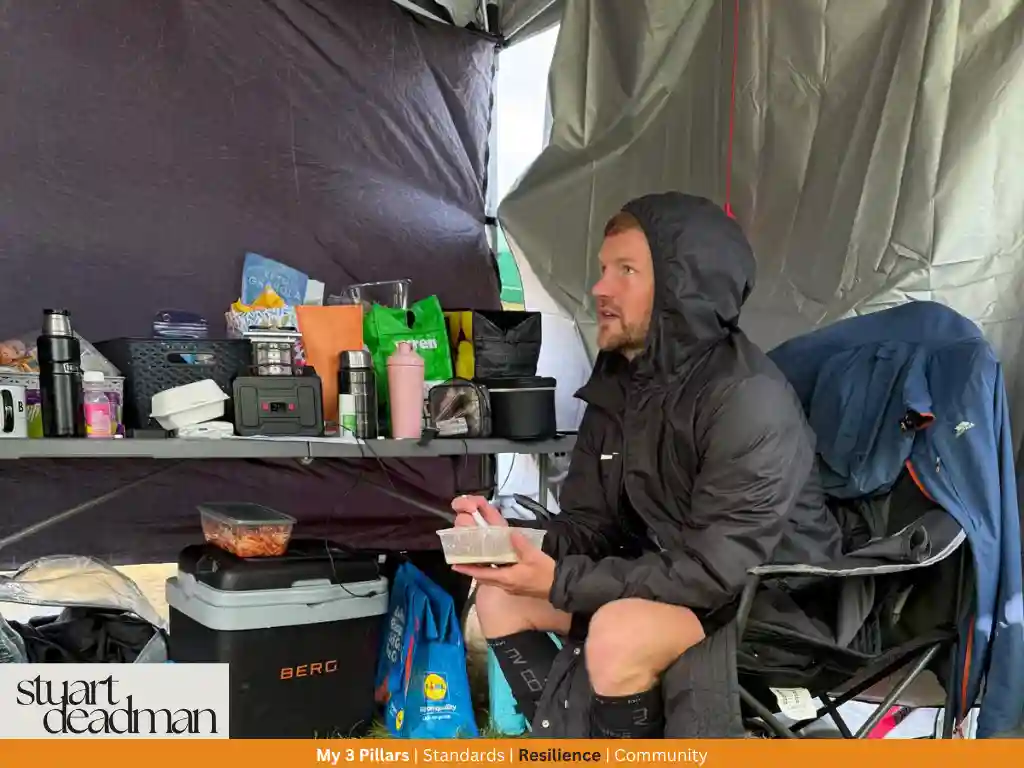
In the Suffolk Back Yard Ultra, runners complete a 4.167-mile loop every hour, on the hour. Complete the loop, and you wait for the next start. Miss it, and your event is over.
I have competed three years running:
- 2023: 25 laps and 104.17 miles
- 2024: 33 laps and 137.51 miles
- 2025: 28 laps and 116.68 miles
At the beginning, it is easy to think about the final result. You have energy, plans and an idea of what you would like to achieve.
Later, the big target becomes less useful.
Thinking about another ten or twenty loops can drain you before you have even started the next one. The only useful question is whether you can prepare properly, get back on the line and complete the loop in front of you.
Business can feel the same. So can recovery, grief, fundraising, leadership and personal change. The full distance matters, but it is rarely where your attention needs to be today.
Make the horizon smaller
When everything feels heavy, people often try to create a huge recovery plan. They write long lists, set unrealistic targets and attempt to repair every part of the problem at once.
That can make things worse.
A better approach is to bring the horizon closer:
- What needs doing in the next hour?
- Which decision is holding everything else up?
- Who needs an honest update?
- What is one action that would leave the situation slightly better than it is now?
The action may look unimpressive. It might be sending one email, making one call, going for a walk or having a conversation you have been avoiding.
It still counts.
Momentum rarely returns through one dramatic decision. It usually comes back through a series of ordinary actions completed properly.
Resilience is not the same as ignoring reality
There is a version of resilience that sounds impressive online but causes damage in real life.
It says you should keep pushing whatever the cost. Ignore the warning signs. Work longer. Sleep less. Never stop. Never admit that you are struggling.
That is not resilience. It is often avoidance dressed up as strength.
The Last Yard Mindset is not about blindly forcing yourself forward. Sometimes the next right move is to rest. Sometimes it is asking for help, changing the plan or admitting that the current approach is not working.
Good endurance athletes adjust. Good leaders do the same.
They pay attention to what is happening, separate discomfort from genuine danger, and make decisions based on reality rather than ego.
Hold the standard when energy drops
Anyone can talk about standards when a project is running smoothly.
The real test comes late, when people are tired, the deadline is close and the temptation to say “that will do” becomes stronger.
That final stretch matters because it is where reputation is often decided. Clients live with the finish. Customers remember how a problem was handled. Teams notice whether a leader stays clear or becomes chaotic under pressure.
The Last Yard Mindset does not mean rushing through the end. It means giving the next part of the job the attention it actually needs.
That may involve:
- slowing down long enough to clarify what “finished” means
- protecting completed work from damage
- resolving a snag properly rather than hiding it
- communicating a delay instead of creating a surprise
- finishing with the same care that went into the start
The final yard is not where standards should weaken. It is where they become visible.
Stop carrying problems alone
One of the biggest mistakes people make under pressure is becoming quieter.
They withdraw, stop communicating and try to solve everything privately. The intention may be to protect other people, but the silence usually increases the weight of the problem.
I have spoken openly about some of my own personal and professional battles because I know what can happen when difficult thoughts stay hidden.
The Last Yard Mindset includes knowing when another person needs to enter the yard with you.
That could mean telling a colleague that you are overloaded, asking someone experienced for advice, speaking honestly to your family or getting professional support.
Strength is not always carrying more. Sometimes it is refusing to keep carrying something alone.
Apply it to leadership
Leaders often create extra pressure by talking only about the distant outcome.
The annual target. The completion date. The final revenue figure. The finished development.
Those things matter, but teams also need to know what good looks like today.
A useful leadership rhythm is:
- Clarify the next meaningful outcome.
- Give it a clear owner.
- Remove the obstacle directly in front of it.
- Communicate what has changed.
- Complete it properly before rushing ahead.
This turns a large, emotional challenge into a sequence of manageable responsibilities.
It also makes leadership calmer. People do not need constant speeches about the finish line. They need clarity about the next yard.
The Last Yard reset
When the full distance begins to feel too big, ask:
- What is true right now?
- What is the next useful action?
- What standard still needs protecting?
- Who needs to hear from me?
- Do I need to push, pause or ask for help?
- What would completing this yard properly look like?
You do not need to solve the whole journey in that moment.
You need to deal honestly with the piece of ground beneath your feet.
Keep moving, but move honestly
The Last Yard Mindset is not a promise that everything works out neatly. It is not motivational noise, and it is not a demand to be endlessly strong.
It is a way of approaching hard periods without allowing their full size to stop you from taking the next useful step.
Sometimes that step is progress. Sometimes it is recovery. Sometimes it is a difficult conversation.
The important thing is that it is real.
Do the next yard properly. Then reassess.
Continue exploring:
Support is available: Samaritans can be reached free on 116 123. For urgent medical advice, call NHS 111. In an immediate emergency, call 999 or 112.