Photos Prevent Disputes and Save Your Build
by Stuart Deadman
Most construction disputes do not begin with one huge mistake.
They usually start with something much smaller.
A conversation that was not written down. A detail that two people understood differently. A change agreed quickly on site. Work that was covered before anyone recorded what was underneath.
Weeks later, the people involved remember the same moment in different ways.
That is where tension starts.
I’m Stuart Deadman, a Norfolk-based construction leader and entrepreneur. One of the simplest lessons I have learned is that clear records protect everyone involved in a build.
Photos are a big part of that. But the real principle is wider:
Record important information while it is clear, not after it becomes a problem.
Photos are not just for progress updates
Most people associate construction photography with marketing.
Finished kitchens. Completed extensions. Before-and-after images. Drone shots showing how far a development has come.
Those photographs are useful, but some of the most valuable images on a build are never shared publicly.
They show:
- services before walls or floors are closed
- reinforcement before concrete is poured
- insulation before plasterboard is fixed
- drainage routes before ground is reinstated
- waterproofing before finishes are applied
- the condition of an existing area before work begins
- the exact stage reached before another trade takes over
These photographs are not glamorous. They are evidence.
They give the project team something objective to return to if a question arises later.
Memory is not a reliable project-management system
Construction projects contain hundreds of conversations.
Some happen in formal meetings. Others happen quickly on site, on the phone or while walking through a room.
People are busy. Circumstances change. Several weeks may pass before a decision becomes relevant again.
Relying on memory creates risk because two honest people can remember the same conversation differently.
One may remember a change as approved. The other may remember it as an idea that still needed pricing.
One may believe a finish was accepted. The other may think they were only shown a sample.
That does not automatically mean anyone is being dishonest. It means the information was never closed down properly.
A short written record can prevent that.
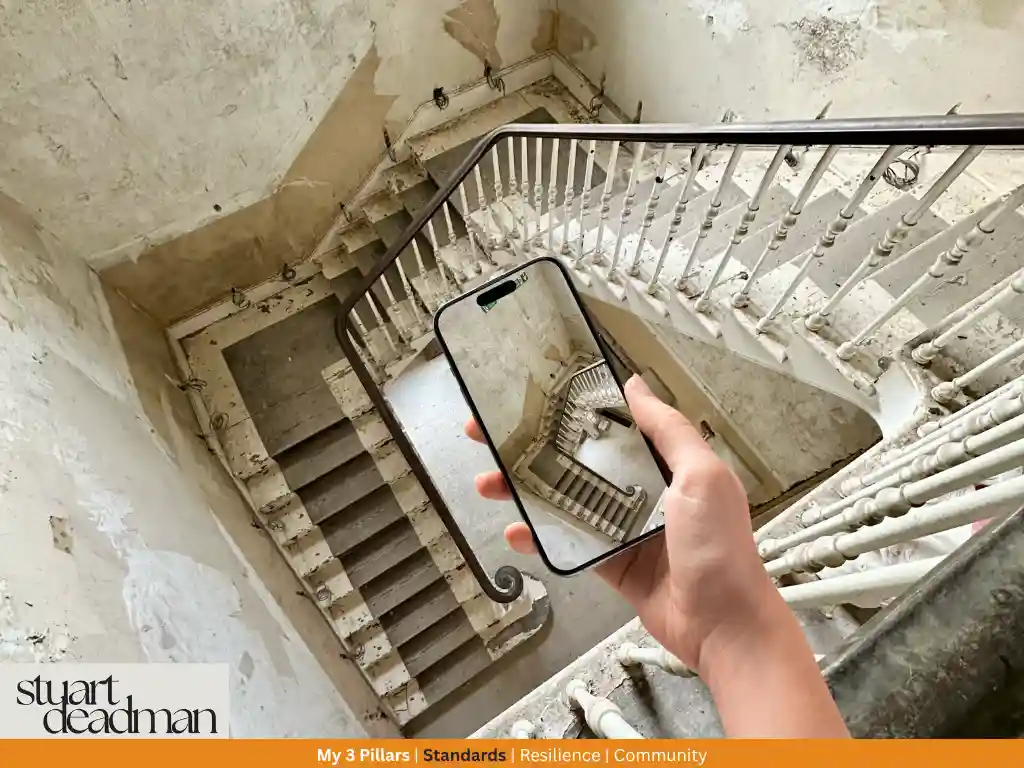
Photograph hidden work before it disappears
A useful rule on any build is:
If it is going to be hidden, record it before it is covered.
Once a wall is boarded, a floor is poured or landscaping is completed, confirming what sits underneath becomes much harder.
That can create problems during later maintenance, future alterations or questions over workmanship.
A hidden-work photo should make sense to someone who was not standing beside the photographer.
That usually means capturing:
- a wide image showing the location
- a closer image showing the detail
- a clear reference point, measurement or room name
- the date and project stage
- a short note explaining what the image shows
A random close-up of a pipe or cable may mean very little six months later. Context is what turns an image into a useful record.
Start with a photographic condition survey
Documentation should begin before the main work starts.
A photographic condition survey records the existing state of the property and any areas affected by access, deliveries or construction activity.
It can include:
- existing cracks or marks
- neighbouring boundaries
- roads, paths and driveways
- walls, floors and finishes being retained
- areas used for material storage
- rooms adjoining the works
- existing fixtures or fittings
This protects the homeowner, contractor and project team.
If damage is discovered later, there is a clear starting point. It becomes easier to establish whether something existed before work began, occurred during the project or is unrelated.
The purpose is not to prepare for an argument. It is to remove one.
Record decisions as well as physical work
Photos can show what happened physically, but they do not always explain why.
That is where a decision log helps.
A decision log can be very simple. It should record:
- the decision required
- the available options
- who is responsible for approving it
- the date approval is needed
- the decision made
- any effect on cost or programme
This is particularly useful for choices involving layouts, finishes, fittings or sequencing.
It also helps prevent decisions from drifting.
A project can lose days or weeks because one choice remained unresolved while different people assumed someone else was dealing with it.
A visible record makes ownership clearer.
Variations should never rely on a verbal agreement
Changes are normal in construction.
A client may choose a different finish. An existing building may reveal something unexpected. A design may need adjusting once work begins.
The problem is not the change. The problem is allowing work to proceed before the consequences are understood.
A variation record should explain:
- what is changing
- why it is changing
- the additional or reduced cost
- any effect on the programme
- who approved it
- the date it was approved
Relevant drawings, photographs or product references should be attached where useful.
This protects the client from unexpected costs and protects the contractor from carrying out additional work without clear approval.
It also gives the team a reliable answer to the question: “How did we get here?”
Keep communication in one place
Documentation becomes less useful when it is scattered across text messages, emails, messaging apps, notebooks and verbal conversations.
A project does not necessarily need complicated software, but it does need a consistent home for important information.
That could be a shared project platform, structured folders or a clearly managed email process.
The system matters less than the discipline behind it.
Everyone should know where to find:
- current drawings
- approved selections
- progress photographs
- decision records
- variation approvals
- weekly updates
- snagging information
When the latest information is easy to find, fewer people work from outdated assumptions.
Use weekly updates to create a rhythm
Documentation should not only appear when something goes wrong.
A short weekly update can prevent uncertainty from building in the first place.
A useful update might include:
- work completed that week
- a small selection of relevant photographs
- work planned for the following week
- decisions required and their deadlines
- current risks and how they are being managed
- any agreed change to cost or programme
The update does not need to be long.
Its job is to make the project visible.
Clients should not have to chase for basic information, and project teams should not have to reconstruct the previous week from memory.
A dependable rhythm creates confidence.
Good documentation improves behaviour
People often think records only matter when a dispute has already started.
In reality, documentation can improve the way a project runs long before that point.
When decisions are recorded, people tend to make them more carefully.
When work is photographed, teams are more likely to check it before covering it.
When variations require approval, vague conversations become clearer.
When ownership is visible, unresolved tasks are harder to ignore.
The record is useful, but the discipline it creates is even more valuable.
Documentation should not become bureaucracy
There is a balance.
Recording every minor conversation can create noise and make the important information harder to find.
The aim is not to document every movement on site. It is to capture information that could affect:
- safety
- quality
- cost
- programme
- design
- maintenance
- responsibility
- the final customer experience
A good system is simple enough to be used consistently.
If it takes too long or nobody understands it, people will stop following it when the project becomes busy—which is exactly when it is needed most.
A simple project-recording checklist
Before work begins:
- complete a photographic condition survey
- agree where project information will be stored
- establish who can approve decisions and variations
- confirm the reporting rhythm
During the build:
- photograph hidden work before covering it
- record important decisions in writing
- update drawings when details change
- confirm variations before additional work proceeds
- send a clear weekly update
Before handover:
- organise the final photo record
- close outstanding variations and decisions
- record test certificates, guarantees and product details
- complete and photograph snagging work
- provide the client with the relevant handover information
None of this is particularly complicated.
That is the point.
Clear records protect relationships
A build is a major investment, and it often involves months of decisions, disruption and financial pressure.
Even good relationships can become strained when people feel uncertain.
Clear documentation removes some of that uncertainty.
It gives clients confidence that work is being managed properly. It gives contractors evidence of what was completed and approved. It helps designers, trades and project managers work from the same information.
Most importantly, it moves difficult conversations away from memory and emotion and back towards facts.
Photos cannot guarantee that a project will never encounter a problem.
They can, however, make problems easier to understand, resolve and learn from.
That can save far more than the build itself.
It can save the relationship around it.
Continue exploring: